Monday, 19 October 2009

Hiroshi Sugimoto 400,000 volt at Frankel Gallery

© Hiroshi Sugimoto. Lightning Fields 128, 2009


A photo exhibition this month at the Fraenkel Gallery in San Francisco showcases the work of Hiroshi Sugimoto.  In his series “Lightning Fields”, Hiroshi Sugimoto uses a Van De Graaf 400,000 volt generator to apply an electrical charge directly onto the film – known as ‘Trouvelot figures’.
The idea of observing the effects of electrical discharges on photographic dry plates reflects my desire to re-create the major discoveries of these scientific pioneers in the darkroom and verify them with my own eyes.
- Hiroshi Sugimoto
The exhibit concludes October 31st.

    Sunday, 11 October 2009

    David Maisel


    The+Lake+Projext+16.jpg

    Abstract, otherworldly and, once your brain has processed what you are seeing, both beautiful and terrifying, David Maisel’s photographs show the impact of man and nature on the earth, seen from the air. Over the last twenty-five years he has created an ambitious series of works that show the scars and marks left on the surface of the earth, from volcanic eruptions to strip mining to the seemingly unstoppable sprawl of cities.
    Photographing the landscape in Washington in the aftermath of the eruption of Mount Saint Helens in 1980, Maisel was amazed at the level of destruction he saw, especially when he and his tutor at the time chartered a light aircraft and flew over the landscape: “The destructive power of this event had altered the landscape on a scale that defied categorization or comprehension. Viewed from the air, these transformations were totemic in scale: whole forests thrown down like matchsticks; riverbeds rerouted through vast debris flows of rock, pyroclastic flow and volcanic mudslides; and countless layers of ash blanketing the flanks of the volcano and surrounding region.” It had a profound effect on him, and influence the direction of his work from then on; alongside the volcanic destruction he also witnessed the brutally transfiguring effect of the forestry industry, clearing up the thousands of felled trees in the region and adding to the carnage. This led him to examine and document other industrial practices, and to realise that destruction on this scale almost had to be shown from the air to convey it: "I first experienced the potency of the aerial view there; I became instantly attracted to its capacity to permit a kind of mapping of the terrain to take place, allowing the creation of images both literal and metaphorical.”
    Subsequent projects included The Forest, a more concentrated look at industrial forest-clearance practices; The Lake Project, a huge series on the disastrous Owens Valley reclamation project in California which left thousands of acres of polluted, unliveable arid land. The Mining Project, begun in 1987, shows the deep scars and photogenic-yet-lethal ‘tailing ponds’ left by increasingly aggressive strip mining practices in Nevada, Arizona and Montana. The striking colours of the lakes and gullies captured alongside the spiralling gouges by Maisel are caused by cyanide, sulphur and mercury amongst others, the unfortunate by-products of these mining techniques.
    The sheer scale of these events and the massive effect they have on the land are hard to compute on a day-to-day basis, especially when we spend much of our time at ground level.  These virtually abstract, contemporary landscapes, from their removed viewpoint, are a powerful record of the constant, long-term, large scale battering the surface of the earth faces. 
    Clicking on the thumbnails will bring up larger scans with much better levels of detail.

    The+Mining+Project+(Ray,+AZ+5).jpg
    The Mining Project (Ray, AZ 5)

    The+Mining+Project+(Inspiration+AZ+4).jpg
    The Mining Project (Inspiration, AZ 4)

    The+Lake+Project+15.jpg
    The Lake Project 15


    The+Lake+Project+3.jpg
    The Lake Project 3


    American+Mine+(Carlin+NV+23)+2007.jpg
    American Mine (Carlin, NV 23)

    Terminal+Mirage+17.jpg
    Terminal Mirage 17

    American+Mine+(Carlin+NV+6),+2007.jpg
    American Mine (Carlin, NV 6)

    Terminal+Mirage+15+(Sprial+Jetty).jpg
    Terminal Mirage 15 (Robert Smithson's Spiral Jetty)


    The+Mining+Project+(Butte+MT+3).jpg
    The Mining Project (Butte MT 3)

    American+Mine+(Carlin+NV+1)+2007.jpg
    American Mine (Carlin, NV 1)


    All images © David Maisel

    Friday, 7 August 2009

    Rineke Dijkstra joins Paul Graham for AUT St Paul Street Gallery workshop


    Rineke Dijkstra will be joining Paul Graham for AUT's School of Art and Design, Summer Photography Workshop at AUT's St Paul Street Gallery. Following last years workshop with John Gossage and Alec Soth, Rineke and Paul will be as good as you can get. Demand will be high for the workshop so if you're interested you can contact Neil Cameron, Registrar School of Art and Design AUT University, Auckland. The workshop runs over January 15, 16 and 17.

    RINEKE DIJKSTRA
    (b. 1959, Sittard, the Netherlands. Lives and works in Amsterdam.)

    Rineke Dijkstra was trained at the Gerrit Rietveld Academy, Amsterdam. Her first solo exhibition took place in 1984 at de Moor in Amsterdam. Dijsktra's photographs have appeared in numerous international exhibitions, including the 1997 and 2001 Venice Biennale, the 1998 Bienal de Sao Paulo, Turin's Biennale Internationale di Fotografia in 1999, and the 2003 International Center for Photography's Triennial of Photography and Video in New York. She is the recipient of a number of awards, including the Kodak Award Nederland (1987), the Art Encouragement Award Amstelveen (1993), the Werner Mantz Award (1994), and the Citibank Private Bank Photography Prize (1998).

    RECENT SOLO SHOWS

    2009
    Park Portraits, La Fabrica, Madrid, Spain
    2006
    Rineke Dijkstra, Portraits, Rudolfinum, Prague, Czech Republic
    2005
    Rineke Dijkstra – Portraits, Galerie Nationale du Jeu de Paume, Paris, France; Fotomuseum Winterthur, Switzerland; Fundació la Caixa d'Estalvis Pensions, Barcelona, Spain; Stedelijk Museum CS, Amsterdam, The Netherlands

    RECENT GROUP SHOWS

    2009
    Listen Darling… The World is Yours, Ellipse Foundation, Cascais, Portugal
    Video Portraits, Smith College Museum of Art, Northampton, Massachusetts
    2008
    Baby, de ideale mens verbeeld 1840-heden, Nederlands Fotomuseum, Rotterdam, The Netherlands
    Street & Studio: An Urban History of Photography, Tate Modern, London, United Kingdom; Museum Folkwang, Essen, Germany
    2007
    Family Pictures, Solomon R. Guggenheim Museum, New York, New York
    Dateline Israel, New Photography and Video Art, The Jewish Museum, New York, New York

    Saturday, 18 April 2009

    James Casebere, Yellow Hallway


    James Casebere builds architectural tabletop models and then photographs them. Casebere’s intent is that his works be seen as models, but the photographs distort the unreality. To add to the confusion, some of Casebere’s models are flooded. But the photos are not simply about the deception of the eye. Casebere brings a strong sense of social history to his work and some of the themes studied range from economics of Southern plantations to the modern-day prison systems. A global variety of interiors are covered by Casebere, from Sienese palazzi to Spanish baths.


    casebere_green_staircase_3_.jpg


    Green Staircase #3


    casebere_siena_feb_06.jpg


    Siena (horizontal)


    casebere_red_room_1_feb_06.jpg


    Red Room #1


    © James Casebere

    Sunday, 25 January 2009

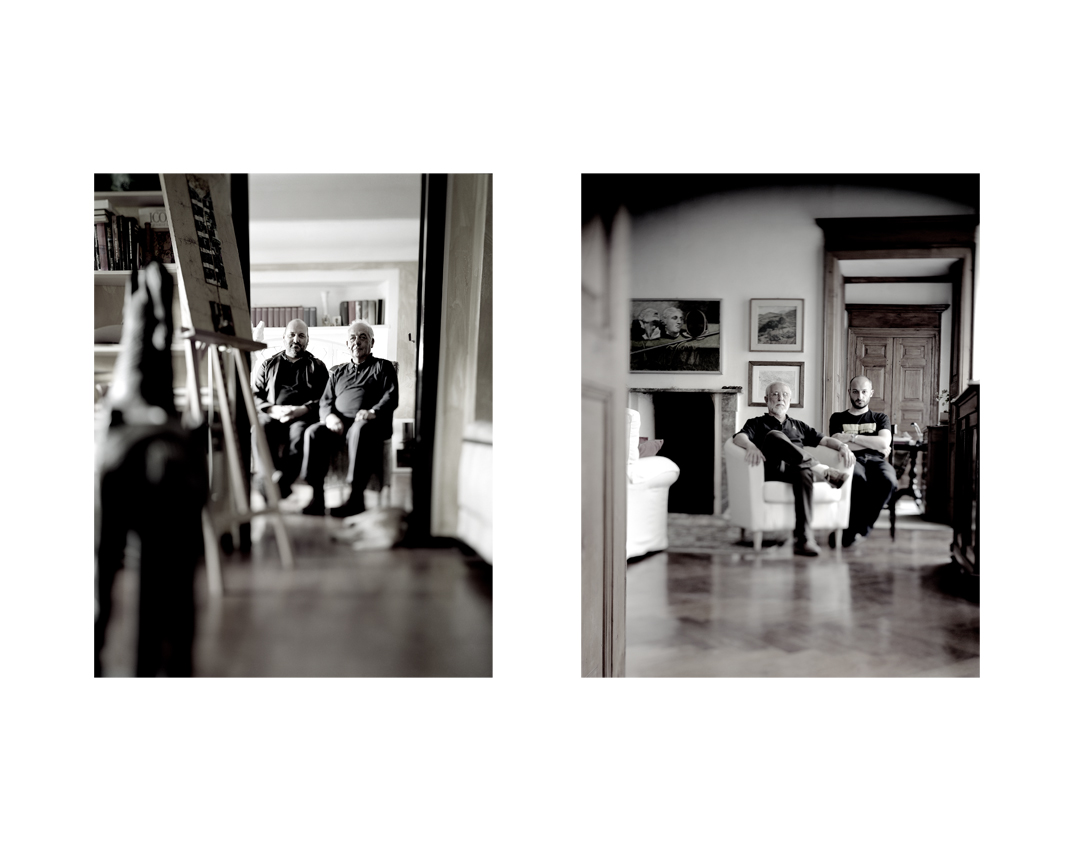
    Fathers and sons - Bepi Ghiotti


    Fathers and sons 2001/2006

    As father as son, We're used to say.
    The project was born due to a self-therapeutic need of a deeper understanding of the
    relationship binding fathers and sons, with the goal of investigating the ancient and 
    unsolved love and hate conflict experienced within these two generations.
    Using long exposure, compared to an instant shot, therefore having to shoot in 
    the dark, in order to achieve longer shooting times, allowed me to consider the deeper 
    meaning of being in front of a camera and brought both the photographer and the 
    people portrayed in a state of greater consciousness and intimacy.
    I asked the couples of individuals, in the age of duty handover, to pose sitting one next 
    to the other, in a place which tells a story of their life together, and wait in the dark 
    so that they would lose any tension, any attitude or pose to then expose the photographic 
    slab for as long as a minute. 

    Leaving a son with his father, still, in a state of abandon 
    where I hide in the time passing by.
    Silence, together, and see what's left.


                 Bepi Ghiotti