Friday, 7 August 2009

Rineke Dijkstra joins Paul Graham for AUT St Paul Street Gallery workshop


Rineke Dijkstra will be joining Paul Graham for AUT's School of Art and Design, Summer Photography Workshop at AUT's St Paul Street Gallery. Following last years workshop with John Gossage and Alec Soth, Rineke and Paul will be as good as you can get. Demand will be high for the workshop so if you're interested you can contact Neil Cameron, Registrar School of Art and Design AUT University, Auckland. The workshop runs over January 15, 16 and 17.

RINEKE DIJKSTRA
(b. 1959, Sittard, the Netherlands. Lives and works in Amsterdam.)

Rineke Dijkstra was trained at the Gerrit Rietveld Academy, Amsterdam. Her first solo exhibition took place in 1984 at de Moor in Amsterdam. Dijsktra's photographs have appeared in numerous international exhibitions, including the 1997 and 2001 Venice Biennale, the 1998 Bienal de Sao Paulo, Turin's Biennale Internationale di Fotografia in 1999, and the 2003 International Center for Photography's Triennial of Photography and Video in New York. She is the recipient of a number of awards, including the Kodak Award Nederland (1987), the Art Encouragement Award Amstelveen (1993), the Werner Mantz Award (1994), and the Citibank Private Bank Photography Prize (1998).

RECENT SOLO SHOWS

2009
Park Portraits, La Fabrica, Madrid, Spain
2006
Rineke Dijkstra, Portraits, Rudolfinum, Prague, Czech Republic
2005
Rineke Dijkstra – Portraits, Galerie Nationale du Jeu de Paume, Paris, France; Fotomuseum Winterthur, Switzerland; Fundació la Caixa d'Estalvis Pensions, Barcelona, Spain; Stedelijk Museum CS, Amsterdam, The Netherlands

RECENT GROUP SHOWS

2009
Listen Darling… The World is Yours, Ellipse Foundation, Cascais, Portugal
Video Portraits, Smith College Museum of Art, Northampton, Massachusetts
2008
Baby, de ideale mens verbeeld 1840-heden, Nederlands Fotomuseum, Rotterdam, The Netherlands
Street & Studio: An Urban History of Photography, Tate Modern, London, United Kingdom; Museum Folkwang, Essen, Germany
2007
Family Pictures, Solomon R. Guggenheim Museum, New York, New York
Dateline Israel, New Photography and Video Art, The Jewish Museum, New York, New York

Saturday, 18 April 2009

James Casebere, Yellow Hallway


James Casebere builds architectural tabletop models and then photographs them. Casebere’s intent is that his works be seen as models, but the photographs distort the unreality. To add to the confusion, some of Casebere’s models are flooded. But the photos are not simply about the deception of the eye. Casebere brings a strong sense of social history to his work and some of the themes studied range from economics of Southern plantations to the modern-day prison systems. A global variety of interiors are covered by Casebere, from Sienese palazzi to Spanish baths.


casebere_green_staircase_3_.jpg


Green Staircase #3


casebere_siena_feb_06.jpg


Siena (horizontal)


casebere_red_room_1_feb_06.jpg


Red Room #1


© James Casebere

Sunday, 25 January 2009

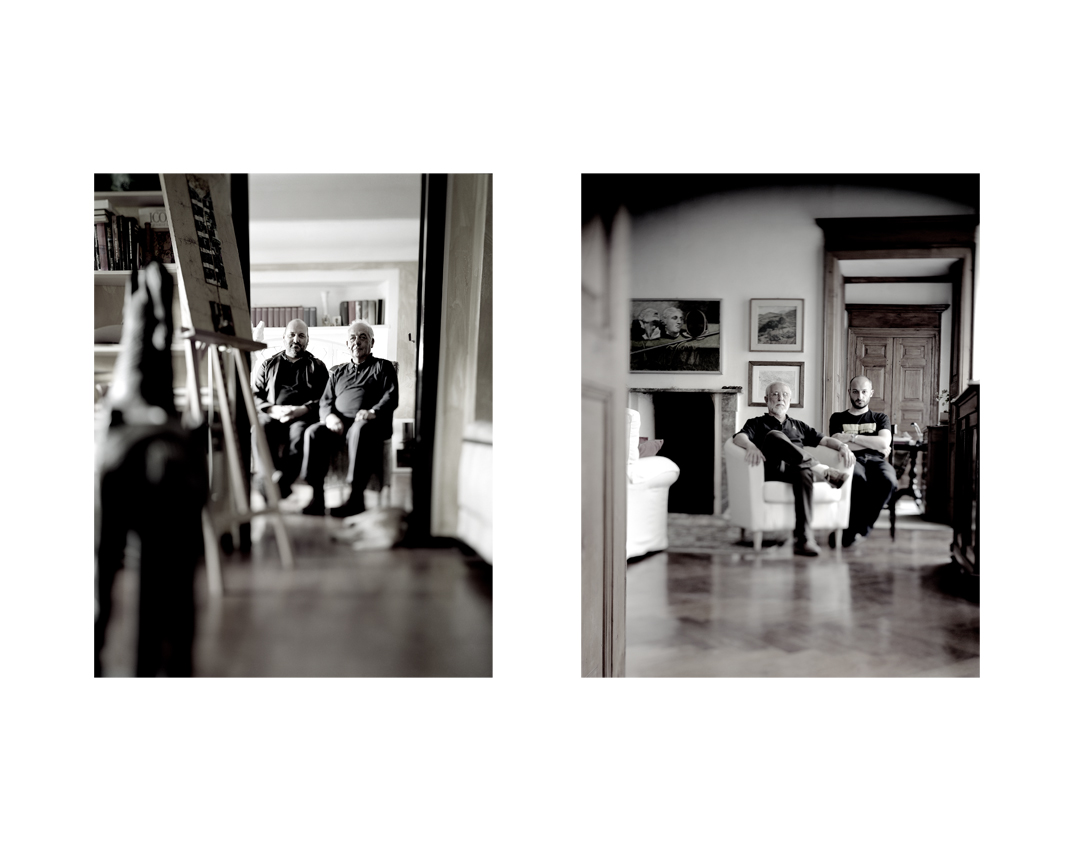
Fathers and sons - Bepi Ghiotti


Fathers and sons 2001/2006

As father as son, We're used to say.
The project was born due to a self-therapeutic need of a deeper understanding of the
relationship binding fathers and sons, with the goal of investigating the ancient and 
unsolved love and hate conflict experienced within these two generations.
Using long exposure, compared to an instant shot, therefore having to shoot in 
the dark, in order to achieve longer shooting times, allowed me to consider the deeper 
meaning of being in front of a camera and brought both the photographer and the 
people portrayed in a state of greater consciousness and intimacy.
I asked the couples of individuals, in the age of duty handover, to pose sitting one next 
to the other, in a place which tells a story of their life together, and wait in the dark 
so that they would lose any tension, any attitude or pose to then expose the photographic 
slab for as long as a minute. 

Leaving a son with his father, still, in a state of abandon 
where I hide in the time passing by.
Silence, together, and see what's left.


             Bepi Ghiotti 


Tuesday, 20 January 2009

Nadav Kander

Head over to Nadav Kander´s site for some real treats but before you do here are a few images from his Yangtze, From East to West project to whet your whistle.


All images ©Nadav Kander

To best appreciate this work one really needs to see the images anywhere but on a computer screen to be honest. I recently had the opportunity to view them when they were on display at what is probably my favourite gallery for checking out contemporary photography in London, Flowers East. In fact, I´ll be there this Friday for the Edward Burtynsky opening so come along and say hello if you are out Hoxton way.

Take the time to sit back and read his artist statement for a fuller flavour of the work. Here it is:

"The Yangtze River, which forms the premise to this body of work, is the main artery that flows 4100miles across china, travelling from its furthest westerly point in Qinghai Province to Shanghai in the east. The river is embedded in the consciousness of the Chinese, even those who live thousands of miles from the river. It plays a pivotal role in both the spiritual and physical life of the people. More people live along its banks than live in the USA – one in every eighteen people on the planet.

Using the river as a metaphor for constant change, I have photographed the landscape and people along its banks from mouth to source. Importantly for me I worked intuitively, trying not to be influenced by what I already knew about the country. After several trips to different parts of the river, it became clear that what I was personally responding to, and how I felt whilst being in china, was permeating my pictures; a formalness and unease, a country that feels both at the beginning of a new era and at odds with itself. China is a nation that appears to be severing its roots by destroying its past by moving forward at such an astounding and unnatural pace. I felt a complete outsider and explained this pictorially by ‘stepping back’ and showing humans as small in their surroundings. Common man has little say in China’s progression, and this smallness of the individual is alluded to in the work.

I feel that there are strong parallels in China with the 20th Century immigrants who poured off the boats onto American soil, a new beginning without roots. Millions of domestic migrant workers are travelling from rural areas to the cities. This condition manifests itself throughout China’s social fabric and echoed my own feelings of dislocation. Further layers have been added to certain images by compositing single figures into a scene, twice removed from their natural habitat. Rather than looking to the future with hope, the photographic migrants appear in limbo, unable to observe their past at a time of uncertain future.

Although it was never my intention to make documentary pictures, the sociological context of this project is very important and ever present. The displacement of 3 million people in a 600km stretch of the River and the effect on humans when a country moves towards the future at pace are themes that will inevitably be present within the work.

A Chinese friend I made whilst working on the project reiterated what many Chinese people feel: ‘Why do we have to destroy to develop?’ He explained that in Britain, many of us can revisit where we were brought up and it will be much the same, it will remind us of our families and upbringing. In China that is virtually impossible. The scale of development has left most places unrecognisable; “Nothing is the same. We can’t revisit where we came from because it no longer exists.”

China is progressing rapidly, and the landscape – both economically and physically – is changing daily. These are photographs that can never be taken again."